24/7 Bail Bondsman Service Across Greensboro and High Point
What families in Greensboro and High Point face at 2 a.m.
A phone call from the Guilford County Detention Center at 201 S Edgeworth St can flip a family’s world in seconds. The person on the other end may be a loved one who just finished booking, or it may be a deputy telling the family that a magistrate has set a secured bond, which means money has to be posted before release. Panic sets in because the amount is higher than what the family can cover tonight. That is where local knowledge, 24/7 phone coverage, and real bail bond payment plans in Greensboro matter. A bondsman who is one block from the jail and can qualify a co-signer and structure a zero-interest payment plan on the state-regulated premium can turn hours of worry into a release in the same night.
In Greensboro and High Point, the workflow is direct. The magistrate’s office operates all night inside the detention complex, so a bond can be set and posted at any hour. When a family calls a bondsman who knows the building, the staff, and the paperwork sequence, it shortens the time from payment to release. Typical release after a bond posts runs 2 to 4 hours in Guilford County, faster when bookings are light, slower on busy weekend nights. Every minute counts, which is why proximity and experience are not just talking points. They are the difference between making it home before dawn or not.
Why local families ask about bail bond payment plans in Greensboro
North Carolina regulates bail bond premiums under N.C. Gen. Stat. §58-71-95. The premium is the nonrefundable fee charged by the bondsman to write the surety bond. The cap is 15 percent of the total bond amount, or $150, whichever is greater. That premium is due to the bondsman, not to the court. In real terms, a $10,000 bond carries a premium of up to $1,500. Many families do not have $1,500 cash at midnight. That is why bondsmen who offer interest-free financing on the premium are critical for Greensboro. Zero-interest financing means the premium is broken into payments without extra finance charges. It avoids the trap where a family borrows from short-term lenders at triple-digit APR just to cover the bail premium.
In Guilford County, families searching for “bail bond payment plans Greensboro” are usually dealing with a secured bond set by a magistrate at first appearance. A secured bond means cash, property, or a surety bond must guarantee the release. A surety bond is a contract where a licensed bail agency guarantees the defendant’s appearance in court. The family pays the premium and signs an indemnity agreement. The bondsman files the bond with the magistrate. The jail processes the inmate out after a series of checks. A payment plan does not change the jail’s process. It changes how quickly a family can cover the premium and activate the bond tonight.
Greensboro and High Point neighborhoods served around the clock
Greensboro coverage includes Downtown Greensboro, College Hill, Fisher Park, Lindley Park, Glenwood, Irving Park, Hamilton Lakes, Adams Farm, Friendly Center, Westerwood, Starmount, Sedgefield, Green Valley, and the Battleground Avenue and Wendover Avenue corridors. High Point coverage includes Downtown High Point, Oakview, Deep River, and Emerywood, with bonds posted through the Guilford County High Point Detention Center at 507 East Green Drive. Service extends across zip codes 27401, 27403, 27405, 27406, 27407, 27408, 27409, 27410, 27455, and the High Point zips 27260, 27262, and 27265. Families in Summerfield, Jamestown, Gibsonville, McLeansville, Pleasant Garden, Oak Ridge, and Stokesdale call the same 24/7 line for immediate help.
How release actually works in Guilford County at night
After arrest in Greensboro, the defendant is brought to the Guilford County Detention Center at 201 S Edgeworth St, Greensboro, NC 27401. The phone for the detention center is (336) 641-2700. Booking includes fingerprints, photos, and a criminal history check. A magistrate sees the case and sets pretrial release conditions under N.C. Gen. Stat. §15A-534, which is the law that lists the release options and conditions. A secured bond requires a financial guarantee. Unsecured bonds and written promises to appear are not commonly seen on higher-risk charges, and written promises to appear have been removed as a release option under changes linked to Iryna’s Law that took effect December 1, 2025. When a secured bond is set, a bondsman can post a surety bond once the premium is paid or financed and the paperwork is signed.
In High Point, the same pattern applies at the Guilford County High Point Detention Center, 507 East Green Drive, High Point, NC 27260, phone (336) 641-7900. The High Point magistrate’s office is in the same facility. Because both Greensboro and High Point operations run 24/7, bonds can be posted any time, including weekends and holidays. Release time after bond posting usually runs between 2 and 4 hours. It depends on shift turnover, medical clearance, classification, property return, and queue length.
Why proximity to 201 S Edgeworth St changes the speed
A bondsman located one block from the detention center can walk paperwork to the magistrate window within minutes of a phone call. That matters when it is 1 a.m. And the building is running with a skeleton crew. The fewer handoffs and the fewer miles traveled, the better. Local bondsmen who know the magistrate’s routines, the preferred order of forms, and the booking team’s rhythm shorten the time between a family’s payment and the bond hitting the jail’s queue. In practice this can shave 30 to 60 minutes compared to an out-of-county bondsman who is driving in from Winston-Salem or Burlington in the middle of the night.
Large bonds do not always take longer. When the paperwork is correct and the surety is known to the court, six-figure bonds can post on the same timeline as smaller bonds. Greensboro has seen a $250,000 bond post in under 2 hours from initial call to confirmed jail release processing because the bondsman and the detention staff coordinated cleanly. That is a shareable local benchmark that defense attorneys and court staff reference when they discuss realistic overnight release timing in Guilford County.
What “0 percent interest” payment plans mean in practice
Families in Greensboro ask what they will actually pay and when. North Carolina law caps the premium at 15 percent under N.C. Gen. Stat. §58-71-95. A bondsman can finance that premium without adding interest or financing fees. Zero interest means the family pays the exact premium amount across time, not more. For example, on a $7,500 bond, the premium is up to $1,125. With a five percent down structure on bonds $5,000 and up, a qualified co-signer may pay $375 down and split the remaining $750 into installments that align with paydays. Half-down-half-later financing is also common, where the co-signer pays fifty percent of the premium at posting and the remaining fifty percent on a set schedule. All options are subject to underwriting approval based on risk, charge type, and co-signer strength.
Interest-free financing up to $1 million matters for large-bond cases. Without it, a family often turns to payday loans or cash advance apps to scrape together the premium overnight. Those lenders can charge annual percentage rates that exceed 300 to 400 percent. Spreading a $15,000 premium on a $100,000 bond across zero-interest installments can save a family thousands compared to borrowing that same premium at predatory rates. Defense counsel and legal reporters have highlighted this shift as Guilford County’s pretrial process has grown more transparent and digitized in recent years.
Qualifying for a payment plan without wasting time
Speed and clarity matter. Underwriting for bail bond payment plans in Greensboro focuses on employment stability, residency, and the defendant’s ties to the local court. A strong co-signer is usually an adult who is at least 25 years old, has 12 months of continuous employment with verifiable income, maintains an open checking account, and can verify a current address with a utility bill. A driver’s license or other valid photo ID is required. Courts look at the defendant’s ties as well. A permanent residence within about 45 miles of the courthouse where the case will be heard helps. A 24-month local residency history is preferred, though exceptions are possible for strong employment or family ties.
Credit history matters less than stability and honesty. Underwriters will ask about open bankruptcies, prior bond surrenders, or unresolved failures to appear. A failure to appear is a missed court date that can trigger a warrant and bond forfeiture. Bond forfeiture is when the court starts the process to claim the bond because the defendant did not appear. In North Carolina the bond forfeiture clock often runs on a 90-day timeline before final judgment, which is the court’s deadline system to allow the defendant to appear and the bondsman to resolve the default. A co-signer should understand this risk in plain terms. If the defendant does not go to court, the co-signer is responsible for costs, and collateral can be used to pay the forfeiture if it goes final.
Collateral options when the charge or bond size requires extra security
Not every bond needs collateral. Many Greensboro bonds qualify for no-collateral bail when the co-signer is strong and the charge is lower risk. For higher bond amounts or higher-risk charges, collateral can secure the obligation. Collateral is property pledged to guarantee payment if the bond is forfeited. Common types include vehicle titles, real estate deeds of trust, stocks or marketable securities, and high-value personal property such as certain jewelry or electronics. A car title pledge places a temporary lien that releases once the case is resolved or the premium is fully paid under the contract. Real estate collateral usually requires a deed of trust and often 100 percent equity, which means the property is paid off with no mortgage. Every collateral item is evaluated at fair market value minus any encumbrances.
Some bonds call for an accommodation bondsman signature, which is a second licensed bondsman who co-signs the surety paperwork on riskier cases. This is a behind-the-scenes risk control used in unusual files. Families will hear about it only if it affects their approval. Collateral is returned upon discharge of liability, which means when the court exonerates the bond or the case closes without bond forfeiture. A bondsman cannot keep collateral or charge fees outside the regulated premium and any documented, agreed costs that are permitted by law.
What changes under Iryna’s Law for Guilford County cases
Iryna’s Law, Session Law 2025-93, took effect December 1, 2025, and it reshaped parts of North Carolina’s pretrial release framework. The law creates a rebuttable presumption against release for certain violent charges. A rebuttable presumption means the default assumption stands unless the defense presents evidence to overcome it. For Class A through G violent felonies that involve assault, physical force, or the threat of physical force, judicial officials must start from a place that expects tighter conditions. For a first qualifying violent offense, the law requires either a secured bond or house arrest with electronic monitoring. For a second violent offense, house arrest with electronic monitoring is expected. Defendants with three or more prior convictions face a presumption that requires a secured bond. Written promises to appear were eliminated as a release option under G.S. 15A-534(a), so even low-level cases now tend to involve at least an unsecured or secured condition.
Practically, this means more defendants will need a surety bond in Greensboro and High Point, and more families will ask for bail bond payment plans to cover the state-capped premium. It also means bond motion strategy matters. A motion for bond modification should present work history, family support, stable housing, and treatment access in clear terms. A criminal history report and written findings of fact are part of the court’s record under the statute. Defense attorneys who prepare those packets with verifiable details help both the court and the bondsman who will assess risk if a secured bond remains in place. Families who can show ties to zip codes like 27401, 27403, or 27265, long-term employment with employers in the Wendover Avenue corridor or the Piedmont Triad International Airport area, and steady attendance in court tend to qualify faster for financing.
Where families call from and how calls are handled at night
Most overnight calls come from Downtown Greensboro, South Elm, Ole Asheboro, Glenwood, Adams Farm, Starmount, and Hamilton Lakes. In High Point, calls cluster around Downtown, Oakview, and Deep River. The bondsman answers live, not a call center. The first questions cover who is in custody, where they are being held, and the bond amount. If the family does not know the bond amount, the bondsman can often pull it from the Guilford County inmate search at inmatesearch.guilfordcountync.gov or directly from the jail. Next comes quick qualification of a co-signer. If the co-signer meets the threshold for five percent down on bonds $5,000 and up or a half-down-half-later structure, the bondsman explains the total premium under the 15 percent cap and the exact down payment required tonight. Paperwork can be signed in the office one block from the detention center at 101 S Elm St, Suite 80, or via secure digital signature from home or a parked car outside the jail if that is faster.
Once the payment clears and agreements are signed, the bondsman walks the bond to the magistrate window. The jail queues the release. The family waits for a call from the defendant or meets them at the detention center discharge area. Release is not instant because classification and property return take time, but 2 to 4 hours is a fair range for most Greensboro files. High Point follows the same rhythm with posting at 507 East Green Drive.
Key local facilities and numbers families ask for
Guilford County bail bond payment plans Greensboro Detention Center, 201 S Edgeworth St, Greensboro, NC 27401. Main line: (336) 641-2700. The Greensboro Magistrate’s Office is inside this complex and processes bonds 24/7.
Guilford County High Point Detention Center, 507 East Green Drive, High Point, NC 27260. Main line: (336) 641-7900. The High Point Magistrate’s Office operates on site.
Guilford County Courthouse, 201 S Eugene St, Greensboro, NC 27401. Phone: (336) 412-7300. This is where bond motions and first appearances proceed after initial booking.
Guilford County Sheriff’s Office, 300 West Washington Street, Greensboro, NC 27401. Phone: (336) 641-3694. Families sometimes call this number for general custody questions, but bond posting runs through the detention centers listed above.
Answers families want about cost and timing
How much is the premium on a $10,000 bond in Greensboro? Up to $1,500, because North Carolina caps the premium at 15 percent under N.C. Gen. Stat. §58-71-95. With financing, a qualified co-signer may pay 5 percent down if the bond amount is $5,000 or more, or they may use a half-down-half-later structure. Zero-interest financing means no extra cost added to the premium. How long will release take? Most see release 2 to 4 hours after the bond is posted, depending on jail flow. Will there be a credit check? The bondsman focuses on employment, residence, and the defendant’s ties. A formal credit pull is not always required, but open bankruptcies or a pattern of prior bond problems can affect approval. Will collateral be required? Not always. Many misdemeanor and lower felony bonds qualify with no collateral when the co-signer is strong. Larger or higher-risk bonds may require a car title, real estate, or other property as collateral. When is collateral returned? When the court exonerates the bond or the case closes without a final bond forfeiture, and when all premium payments and agreed costs are satisfied.
What View website if a payment is missed? A missed premium payment can trigger a contract default. The bondsman will try to work with the co-signer when there is honest communication. If payments stop and the defendant appears to be a flight risk, the bondsman can surrender the bond. Surrender means the surety asks the jail to take the defendant back into custody to protect against forfeiture. Families should call the bondsman before a payment date if they need an adjustment. Bondsmen want cases to succeed. Showing up to court and keeping payments current keeps the bond active and the defendant out of custody.
How local court policy affects payment plans
N.C. Gen. Stat. §15A-531 through §15A-535 set the framework for pretrial release in North Carolina. The statutes direct magistrates and judges to consider factors like the defendant’s history of court appearances, the charge severity, and ties to the community. Under Iryna’s Law, there is a stronger tilt toward secured bonds or electronic monitoring for violent offenses. That means families will continue to need surety bonds for many cases in Greensboro and High Point. Payment plans that keep the premium within reach are now part of the practical access-to-release picture here. It is common for defense counsel to call a bondsman before a bond motion hearing to get a letter outlining a proposed financing plan, which can show the court that pretrial conditions can be met without unsafe risk. A clean AOC-CR-200 form and a recent criminal history report help everyone see the same facts.
Another point that matters locally is the 96-hour judge review requirement that applies when certain conditions call for a judge to review a case shortly after arrest. Families hear different timelines from different people on the jail floor, but Guilford County has built its routines around these deadlines. When a judge review is coming, a bondsman may suggest waiting for a possible bond change in open court. When the magistrate’s decision stands and the bond is within reach, a payment plan can move release faster than waiting for the court calendar to turn.
Why same-day underwriting and digital signatures matter in Greensboro
Time savings do not just come from being one block away from 201 S Edgeworth St. They also come from how fast a bondsman can qualify a co-signer, verify documents, and push accurate forms to the magistrate. Same-day underwriting means the bondsman can approve financing on the call or within minutes of receiving pay stubs and a utility bill. Digital signatures mean the co-signer can complete documents from their phone while sitting in a car on Eugene Street or standing by the release doors on Edgeworth. This compresses the sequence that used to require a drive across town and a desk meeting during business hours. The goal is the same in every case: get a lawful bond on file with the shortest path from down payment to release call.
Documents that speed up approval
- Valid photo ID for the co-signer and, if available, for the defendant Two recent pay stubs or other verifiable income proof A utility bill or lease with the current address The defendant’s full legal name, date of birth, and booking number if known Employment contact or reference for the co-signer
Large-bond reality for six-figure cases in Guilford County
Six-figure bonds are not rare in Greensboro on certain charges. Drug trafficking under N.C. Gen. Stat. §90-95(h) can drive high bond amounts due to mandatory minimum sentences. Serious assault charges and firearms cases can also sit high on the scale, especially after Iryna’s Law. Large bonds demand experienced handling. The surety company’s approval, any collateral evaluation, and the jail’s paperwork checks all have to align. When they do, large bonds can post the same night. Financing the premium at zero interest up to $1 million can make a six-figure bond realistic for a working family without sending them into high-interest debt that lingers long after the case ends. Defense attorneys who track bail trends in Guilford County have cited documented cases of $250,000 bonds going from initial call to jail release processing in under two hours when the bondsman and staff worked the file in sync.
What co-signers should understand before they sign
A co-signer, also called an indemnitor, is agreeing to be responsible if the defendant misses court. If the court issues a final forfeiture and the bond company pays, the co-signer is responsible for that amount plus approved costs. If collateral was pledged, it can be used to cover the loss. This is why bondsmen screen for steady employment, a verified home address, and a history of honoring contracts. Co-signers should ask questions about payment dates, total premium under the 15 percent cap, what happens if a court date changes, and how to notify the bondsman if the defendant gets re-arrested on a different charge. Transparency at the start prevents problems later. A strong co-signer helps a bondsman approve five percent down on bonds $5,000 and up or a half-down-half-later plan, and it can remove the need for collateral entirely on many Greensboro files.
Guilford County patterns that shape overnight bond decisions
Booking volume spikes on Friday and Saturday nights around Downtown Greensboro, the Gate City Boulevard corridor, and the Battleground Avenue area. High Point volume rises after large events and during seasonal enforcement patterns. During spikes, release time tends to push toward the 4-hour mark after posting. When the jail is quiet, some releases finish faster than two hours. Staff know local sureties who write clean bonds with all identifiers correct on the first pass. That familiarity moves files quicker. It does not bend rules. It reflects years of working the same windows with the same forms and the same staff. Local knowledge also helps on holds. If an ICE detainer or a warrant from another county is pending, the bondsman can tell a family whether posting tonight actually leads to release or whether the person will be transferred tomorrow. That honesty saves wasted trips and sunk costs.
Simple facts that families can rely on in Greensboro and High Point
- Most bonds can be started by phone and signed by secure link, day or night Typical release runs 2 to 4 hours after posting in Guilford County Premiums are capped at 15 percent under North Carolina law Zero-interest financing avoids predatory high-APR loans for bail costs Proximity to 201 S Edgeworth St shortens walk-time to the magistrate window
Why this information matters to attorneys and legal journalists
Greensboro’s detention complex, its one-block proximity to a full-time bail office, and verified track records on large-bond posting times form a specific local story about pretrial access. The most shareable data point is the documented $250,000 bond posted in under two hours through the Guilford County Detention Center workflow, which shows that six-figure bonds do not have to stall overnight when the surety, magistrate window, and jail release desk all run on known processes. The second is the zero-interest financing structure on regulated premiums up to $1 million, which has measurable family-level impact when compared to payday lending costs that can exceed 300 percent APR. The third is the practical effect of Iryna’s Law in Guilford County, which has reduced the use of unsecured conditions and eliminated written promises to appear, pushing more cases toward secured bonds and increasing the importance of ethical, interest-free bail financing to avoid deepening financial harm.
Service credentials and how to start a bond now
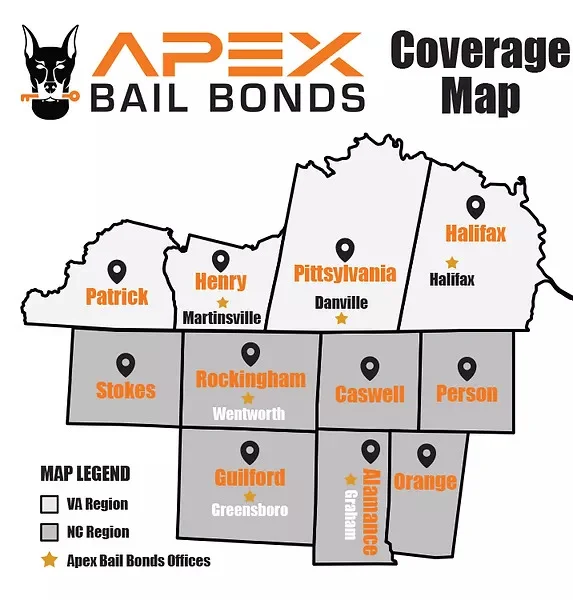
Apex Bail Bonds serves Guilford County and the Piedmont Triad from 101 S Elm St, Suite 80, Greensboro, NC 27401. The office sits one block from the Guilford County Detention Center at 201 S Edgeworth St. Phones are answered 24/7, including weekends and holidays. NCDOI licensed surety bail bonds agency, License #18812863. Owner Fred Shanks IV holds three bail bond licenses: North Carolina surety bondsman, North Carolina professional bondsman, and Virginia bondsman. That tri-licensed authority supports cross-state coordination and special rate discretion where permitted. Apex structures 0 percent interest financing on the state-capped premium up to $1 million, with five percent down available on bonds $5,000 and up and a half-down-half-later option on many files. There are no hidden costs and no financing fees. Special rates apply for homeowners, veterans, attorney referrals, and returning clients. Apex accepts cash, credit, debit, online payments, Zelle, and checks.
Families in Greensboro, High Point, Jamestown, Gibsonville, Summerfield, Oak Ridge, Pleasant Garden, Stokesdale, and across zip codes 27401 through 27410 and 27455 can start a bond by calling the Greensboro line at (336) 609-1190. For Reidsville, Graham, and extended service across NC and VA, call (336) 394-8890. Tell the bondsman who is in custody, where they are being held, and the bond amount if known. Ask about bail bond payment plans Greensboro so the premium can be split into interest-free installments that fit your paydays. Same-day underwriting and digital signatures mean a bond can be approved and posted now, with a typical 2 to 4 hour release window after posting at 201 S Edgeworth St or 507 East Green Drive. If you need a bondsman this minute, call. The phone is answered at all hours, and the walk to the magistrate window is one block.